Showing posts with label nonviolence. Show all posts

Friday, June 4, 2010

Gaza

Would there be a Palestinian problem if Israel treated Palestinians the way it treats Jews? No, because Palestinians would be and would have have been treated as neighbors and as partners in building a homeland for them both. But politics intervened and we have what we've had since 1948 -- a divided land seething with resentment and violence.

This has particularly been the case since the 1967 war when Israel took the West Bank and Gaza from Jordan and Egypt respectively and occupied it, promising the Palestinian residents their freedom but never giving it to them. As journalist Robert Scheer writes, "There is no such thing as a morally acceptable occupation, and as the oppressed resist they will become more violent in their desperation. In turn the occupiers will show their true colors as oppressors.
"

The secret to stopping the violence and improving Israel's security needs is, as Scheer so eloquently says, to treat Palestinians the same way as Jews are treated, with dignity and respect.

The other day Israel again tried to crush dissent and protest by attacking it. The attack, in which 9 civilians were killed and 600 arrested ("kidnapped" is perhaps the better word), backfired. New boatloads of nonviolent protesters bearing building materials, medical supplies and food are on their way and more are planned.

If Israel wishes peace and the respect of its neighbors and the world, it must immediately cease its blockade of Gaza, discontinue the illegal settlements in the West Bank that have but one purpose, and that is to occupy the whole of the West Bank and prevent any hope of the Palestinians having their own homeland. If Israel wishes to destroy itself, the best way to do it is to continue what it's doing. If it wishes to live and prosper, the only way to do that is to begin treating everyone with respect as human beings.

The Palestinian people are good people who deserve better. Two excellent resources to increase your understanding are Naomi Shihab Nye: "Habibi", and Ramzy Baroud: "My Father Was a Freedom Fighter: Gaza's Untold Story".

All for this post,

Toasty


Wednesday, December 9, 2009

For a future to be possible

Does it seem to you, as it does to me, that for a future to be possible on this planet, we – each of us – has got to do something to turn things around so that a future is possible for our children, grandchildren and beyond?

“The day we stop killing off our own species,” writes Zoe Taylor of McClure Middle School in Seattle, WA, “our world will become a book with no more torn pages.” (Source: Wisdom Commons, www.wisdomcommons.org.) That ought to be so obvious that no one would question it. Yet people go on killing each other every day in acts of war and vengeance.

Are there active movements where you live to reduce violence and the madness of war? If there are, what are they? If there aren’t, why not? What prevents such  movements from happening? Historian Andrew Bacevich has written that Americans are seduced by war (“The New American Militarism”). I am convinced that America and its citizens are seduced by violence. It’s in our militarism, our video games, our domestic relations, our language and in our gangs. Is this true where you live? What can you – can we – do to change this where we live? What are we willing to do.

For the first time in my life, I live in a country – Japan – that is committed to the peaceful means of solving conflicts. Nonviolence has been written into its Constitution since the end of World War Two. Does this mean that war thinking has ended? Not at all. It means that the nation, and its people are dedicated to seeking peaceful means to solving conflicts. Looking back at the horrors of World War Two, the Japanese people wanted nothing to do anymore with war and warmongers, and they have stuck resolutely by that and demanded that their politicians and military leaders do the same. (The last military officer to publicly rattle his sword, a four-star Air SDF general, was summarily fired from his job earlier this year and mustered out of the Self Defense Force.)

South Africa changed from a White controlled government to a racially inclusive government led by Nelson Mandela without the eruption of violence and hate that most people had predicted. And in Northern Ireland, in spite of occasional outbursts of sectarian violence, the people and their leaders seem committed to a peaceful future.

For a future to be possible we, as individuals, neighbors, communities and nations, must begin committing ourselves to beliefs, attitudes and activities that bring a peace that respects our differences.

What do you think?

All for this post,

Toasty


Sunday, November 8, 2009

A wonderful story for young adults of any age

Review of “Habibi”, by Naomi Shihab Nye. Mass Market Paperback. Simon Pulse, 1997.

Naomi Shihab Nye brings her poet's voice to this touching story about 14 year old Liyana Abboud and her family as they move from St. Louis, Missouri to Palestine, where her father, a physician, was born and raised. The move isn't an easy one, for more reasons than one. The family arrives to find conditions more tense than they had expected, with growing violence and a growing Israeli military presence in the West Bank. The story is also filled with some memorable characters, one of the most memorable being Sitti, Liyana's 81 year old grandmother, who is the “glue” that holds her large family together, a veritable font of energy and wisdom.

It isn't easy being an American teenager in Israel, especially when you're half-Arab and half-American and female. The rules are very different (and Liyana tests them, as any self-respecting teenager will), you don't understand the language, dad (“Poppy”) has to do all the translating, you don't “fit” anywhere, and the tensions between your father's people (and hence your own) and the powers that be in Israel grow daily. To complicate matters, a friendship develops between (and warms) between Liyana and a Jewish teenager named Omer (she mishears his name as “Omar”). It is a time of hardening positions and escalating violence. “Did people who committed acts of violence think their victims and their victims' relatives would just forget? Didn't people see? How violence went on and on like a terrible wheel? Could you stand in front of a wheel and make it stop? ... It was better ... if you were able to let the violence stop when it got to you. But many people couldn't do that.” When a Jewish deputy mayor of Jerusalem proposes that two thousand Arab homes in east Jerusalem be torn down to make room for fifty thousand houses for Jews, and nothing is said “about pain or attachment or sorrow or honor”, what happens? When someone knocks on your door, walks in and kicks you and your family out without so much as a by-your-leave, and you lose everything, what's the logical consequence? These are the issues that Liyana, her family, and every other human being in that part of the world (and in many others) had and have to deal with every day of their lives.

As grandma Sitti says to Omer “You will need to be brave. There are hard days coming. There are hard words waiting in people's mouths to be spoken. There are walls. You can't break them. Just find doors in them. See?”

Ms. Nye does a wonderful job of painting in the details of her story in vivid color, images and anecdote.

This may be a book for young adults. In my view, it is a book that everyone should read.

All for now,

Jorge Luis Tostada (“Toasty”)

Sunday, August 9, 2009

A hero

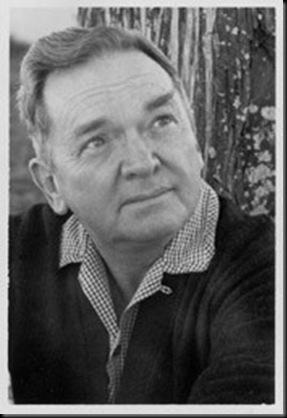
Clarence Jordan


Our news is so full of people who do all they can to attack, belittle and tear down that I’ve decided to dedicate the next few posts to people who stand up, confront wrong, build up, heal, and comfort – people who live by their beliefs in spite of all the garbage, violence and trash that is heaped on them. This is the first installment, and my hero is Clarence Jordan.

Clarence Jordan was born in Talbottom, Georgia in 1912, and died suddenly of a heart attack at age 59 in 1969.

Clarence Jordan lived what he believed, and he believed in living Jesus’ teachings in the Sermon on the Mount, binding oneself to the equality of all persons, rejecting violence, ecological stewardship, and common ownership of possessions. In 1942 he and his wife moved to a 440 acre farm near Americus, George, calling it “Koinonia”, a Greek work that means fellowship.

Until the advent of the civil rights movement, their neighbors generally left them to live and farm in peace; then Koinonia became the target of a stifling economic boycott and repeated violence, including several bombings.

I met Clarence Jordan at a conference for Baptist ministers in a Chicago suburb in 1963, where he spoke about the civil rights movement and the response (or lack of) of the White churches in the South. A Bible scholar, we were eager to hear what he had to say about the civil rights movement that some claimed was “tearing our nation apart”. Interesting how discomfort turns reality around: It wasn’t racism that was tearing our nation apart, it was opposition to it.

In his quiet, red clay south Georgia drawl, Clarence Jordan said it. The churches, both large and well-known and tiny and unknown, had turned Blacks and their supporters away and in so doing, turned their backs on everything that Jesus taught and stood for. He said it quietly, eloquently and pointedly.

By the end of his first presentation, there was a lot of discomfort in that room. When we returned from lunch, with all of the local Church bigwigs seated behind us, he began by saying that they had asked him to apologize for saying what he had said about the churches negative response to the civil rights movement.

With each of the bigwigs looking pleased, he began his apology. And with each word he spoke, the white faces seated behind him turned to scarlet. I don’t recall Clarence Jordan’s apology other than to say that it turned their words back on them as a scathing indictment.  All delivered in his quiet broad red-clay Georgia drawl.

It was brilliant, it was deserved, and I was happy that I wasn’t on its receiving end. It, and the man who delivered it, stand as beacons to me of heroic living.

So I give you Clarence Jordan, one of my heroes, as a life to be emulated.

Among other writings, Clarence Jordan was the author of the Cotton Patch translation of the New Testament. Here is a sample, from his translation of Paul’s letter to Ephesians, which he translates as “The Letter to the Christians in Birmingham.” You’ll see why the church bigwigs at that conference were so uptight:(from Ephesians 11-13):

"So then, always remember that previously you Negroes, who sometimes are even called "niggers" by thoughtless white church members, were at one time outside the Christian fellowship, denied your rights as fellow believers, and treated as though the gospel didn’t apply to you, hopeless and God-forsaken in the eyes of the world. Now, however, because of Christ’s supreme sacrifice, you who once were so segregated are warmly welcomed into the Christian fellowship."

Hard to misunderstand, isn’t it?

That’s all for this post,

Toasty